Introduction: The Vacuum Left by Biggie
When The Notorious B.I.G. died in 1997, he didn’t just leave a legacy; he left a throne empty. The “King of New York” title was suddenly up for grabs, and two men stepped forward to claim it.
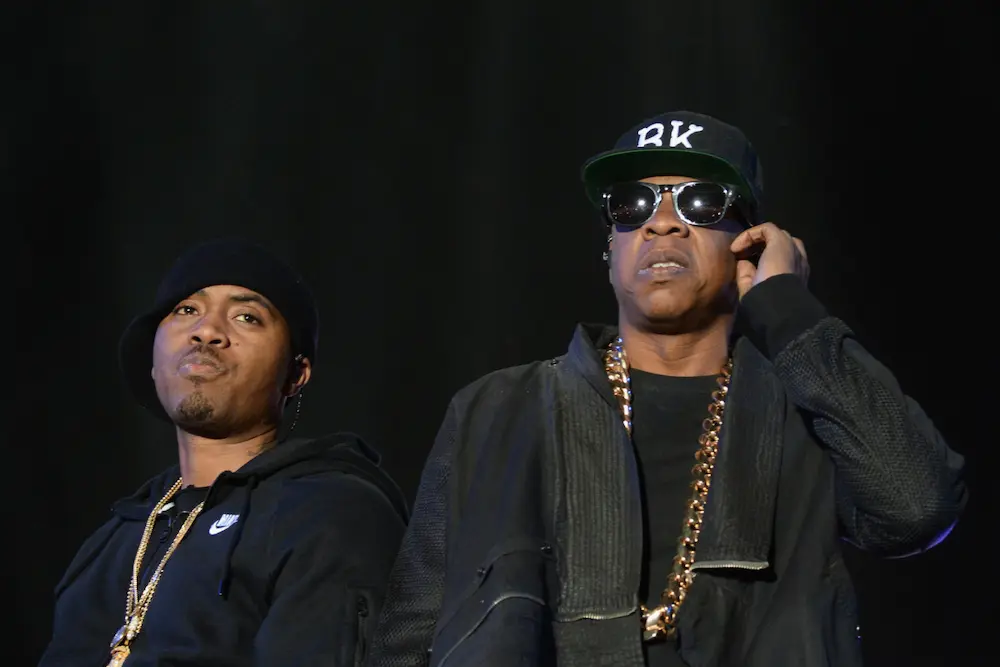
On one side, there was Nas from Queensbridge, the lyrical prodigy who had released arguably the greatest hip-hop album of all time, Illmatic, at just 19 years old. On the other side, there was Jay-Z from the Marcy Projects in Brooklyn, the hustler-turned-CEO who was dominating the charts with a flashier, radio-friendly sound.
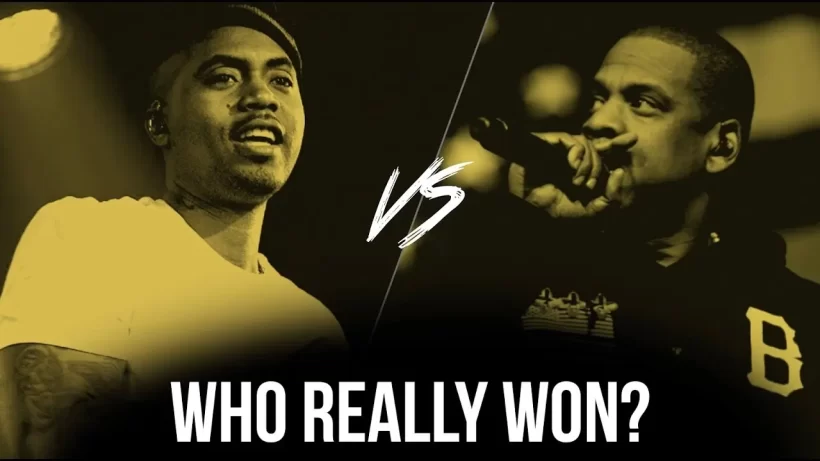
For years, this was a “Cold War”—a series of subliminal jabs and hidden insults. But in 2001, the tension exploded into the most famous lyrical battle in history. It wasn’t just about rap; it was a battle for the soul of New York City.So, who really won? Was it Jay-Z with the surgical facts of “Takeover,” or Nas with the raw aggression of “Ether”? In this definitive history, we break down the Jay-Z vs Nas beef round by round.
The Context: New York Under Siege
To understand the pressure on Jay-Z and Nas, you have to look at the state of New York in 1997. The city wasn’t just grieving Biggie; it was losing its dominance. The West Coast was taking over. Snoop Dogg and The Dogg Pound had famously kicked over buildings in their “New York, New York” music video, disrespecting the entire East Coast. The city felt under siege. The fans were desperate for a savior. They needed a new King to defend the territory. While Jay-Z was building a commercial empire with In My Lifetime, Vol. 1, Nas was seen as the lyrical chosen one. The friction wasn’t just personal; it was about who would lead New York back to the top.
Round 1: The Cold War (1996–2000)
Before names were named, the shots were subtle. It was shaping up to be the modern sequel to the legendary Bridge Wars, but this time for the entire city. The tension officially began regarding the “King of New York” title following Biggie’s passing.
The “Reasonable Doubt” Snub Jay-Z had always admired Nas. In fact, he originally wanted Nas to appear on his debut album, Reasonable Doubt (1996), on the track “Bring It On.” Nas never showed up to the studio. Instead, Jay-Z sampled Nas’ voice for the chorus of “Dead Presidents II.” While this seemed like homage, it planted a seed of competition.
The Memphis Bleek Factor
The proxy war started with Memphis Bleek, Jay-Z’s protégé. On the intro to his album Coming Of Age, Bleek rapped lines that many felt were directed at Nas. Nas responded directly on his track “Nastradamus,” rapping:
“You wanna ball till you fall, I can help you with that / You want beef? I could let a slug melt in your hat.”
Jay-Z took this as a direct threat to his camp. The era of subliminals was ending.
Round 2: The Declaration of War (Summer Jam 2001)
The cold war turned hot on June 28, 2001, at Hot 97’s Summer Jam. This wasn’t just a concert; it was a public execution.
The Prodigy Incident
Jay-Z didn’t just target Nas; he targeted Queensbridge. During his performance, he put a humiliating photo of Prodigy (from Mobb Deep) on the giant screen. The photo showed a young Prodigy dressed in a dance outfit, questioning his street credibility.
The First Verse of “Takeover”
At the end of the show, Jay-Z debuted the first verse of what would become “Takeover.”He famously rapped:
“Ask Nas, he don’t want it with Hov. No!”
This was the first time Jay-Z had publicly called out Nas by name. The crowd went wild. The gauntlet was thrown.
The Michael Jackson Flex
To understand how powerful Jay-Z was at this moment, you have to look at his guest list. He didn’t just bring out rappers; he brought out Michael Jackson. Imagine the scene: Jay-Z brings out the King of Pop for a photo op, driving the crowd into a frenzy. Moments later, he uses that same stage to publicly execute Prodigy and Nas. It was a masterclass in power dynamics. By standing next to MJ, Jay-Z was visually telling the world: “I am the biggest star here. Nas and Mobb Deep are beneath me.”
Round 3: The Surgical Strike: “The Takeover”
Jay-Z included the full version of “Takeover“ on his classic album The Blueprint (released September 11, 2001). This track is widely considered one of the most effective diss tracks ever because it didn’t rely on insults; it relied on facts.
The Analysis: Jay-Z approached the diss like a corporate audit of Nas’ career. He broke down Nas’ discography mathematically:
- The “One Hot Album” Theory: Jay-Z claimed Nas had only one good album (Illmatic) and had been releasing garbage for a decade.
“Four albums in ten years, ni**a? I could divide / That’s one every two, two of them shits was doo.” - The Fake Gangster Narrative: He exposed that Nas didn’t live the street life he rapped about.
“Nigga, you ain’t live it, you witnessed it from your folks’ pad / You scribbled it in your notepad and created your life.”
“Takeover” was devastating because it sounded true. It painted Nas as a has-been artist living off past glory. Critics and fans declared the battle over. Nas was dead.
The Ballerina Photo: Destroying Prodigy
While Nas was the main target, Jay-Z’s attack on Prodigy (of Mobb Deep) was arguably more brutal. Jay-Z dug up an old photo of a young Prodigy attending a dance school, dressed in a leotard/dance outfit. He rapped:
“You was a ballerina, I got the pictures, I seen ya / Then you dropped ‘Shook Ones,’ switched your demeanor.”
In the hyper-masculine world of early 2000s hip hop, this was character assassination. Jay-Z stripped Prodigy of his “thug” image in seconds, proving that he did his research. He wasn’t just rapping; he was exposing secrets.
Round 4: The Nuclear Response: “Ether”
Nas was backed into a corner. His career was fading, his mother was battling cancer, and the biggest rapper in the world had just humiliated him. On his birthday, December 4, 2001, Nas released Stillmatic. The intro track was “Ether.”
Why “Ether” Changed Everything If “Takeover” was a surgical strike, “Ether” was a nuclear bomb. Nas didn’t use facts or math; he used pure, unadulterated disrespect.
The Attacks:
- Appearance: He attacked Jay-Z’s looks (calling him “Camel” and comparing him to J.J. Evans).
- The “Fan” Angle: Nas flipped the script, claiming Jay-Z wasn’t a rival, but a fan who idolized him.
“In ’88 you was getting chased through your building / Calling my crib and I ain’t even give you my numbers.” - Eminem’s Shadow: He claimed Eminem murdered Jay-Z on his own track (“Renegade“).
“Eminem murdered you on your own sht.”
The Cultural Impact: “Ether” became a verb in the hip-hop dictionary (to “Ether” someone means to utterly destroy them). The streets of New York voted overwhelmingly for Nas. The raw aggression resonated more than Jay-Z’s corporate logic.
The “Tae Bo” Hoe: Deconstructing the Tough Guy
Nas didn’t just call Jay-Z ugly; he questioned his fighting skills and street toughness. In one of the most disrespectful sequences in rap history, Nas ridiculed Jay-Z’s obsession with martial arts imagery:
“You love the attention, you came from a perilous school / No you didn’t, you a Tae Bo hoe.”
He followed up by mocking Jay-Z as a 36-year-old man taking karate classes just to feel tough. “Thirty-six in a Karate class? You T-Bo hoe.” These lines painted Jay-Z not as a king, but as an insecure older man trying too hard to be cool. It flipped the “Takeover” narrative (that Nas was fake) right back onto Jay-Z.
Round 5: The Low Blow: “Supa Ugly” & The Apology
Jay-Z, shocked by the reception of “Ether,” panicked. He rushed to the studio and recorded a freestyle called “Supa Ugly“ over Dr. Dre’s “Bad Intentions” beat.
The Carmen Bryan Reveal Jay-Z decided to get personal. Extremely personal. He revealed that he had slept with Carmen Bryan, the mother of Nas’ daughter, and even left condoms in the baby seat of the car.
“Me and the boy AI got more in common than just balling and rhyming / Get it? More in Carmen…”
The Backlash: It went too far. Even Jay-Z’s own mother, Gloria Carter, called him and told him he was out of line. Consequently, Jay-Z went on Hot 97 the next day and publicly apologized to Nas and his family.
“I felt like I didn’t think about women’s feelings… So I apologize.” — Jay-Z
This apology is often cited as the moment Jay-Z officially “lost” the battle. In hip-hop, you don’t apologize during a war.
The Reconciliation: “I Declare War” (2005)
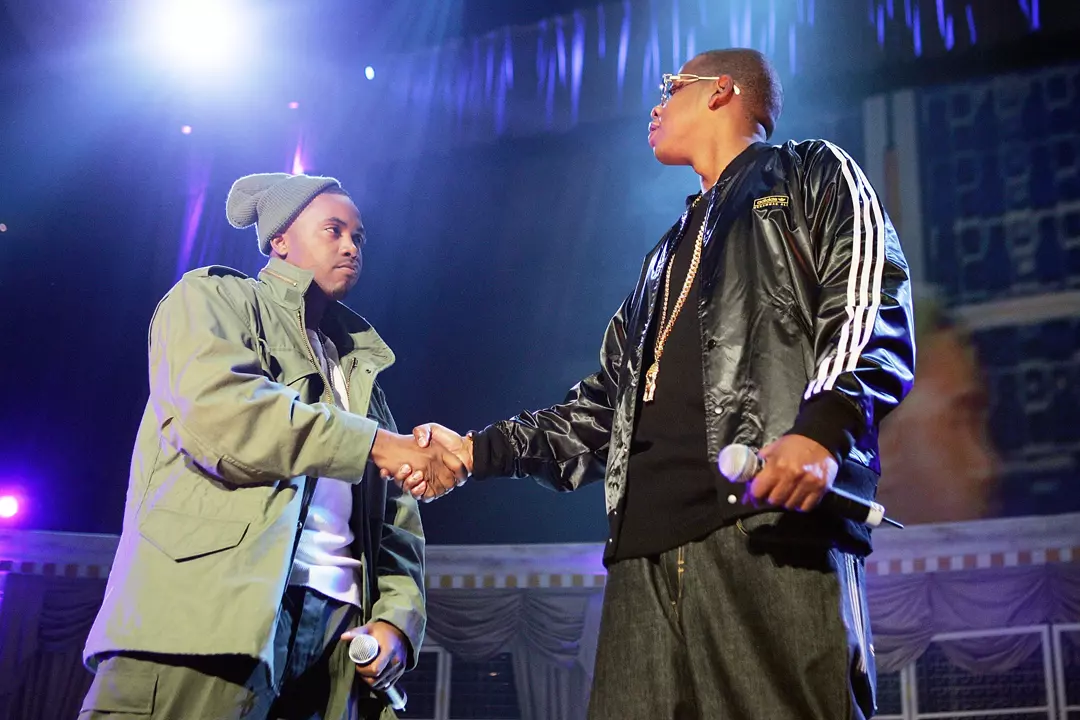
The beef simmered for years, but the grand finale wasn’t violent; it was business. In October 2005, during his “I Declare War” concert, Jay-Z shocked the world.
He brought Nas out on stage. The two legends shook hands and performed “Dead Presidents” and “The World is Yours” together. Jay-Z famously announced:
“All that beef sh*t is done. We moving on. It’s bigger than that.”
Shortly after, Jay-Z (now President of Def Jam) signed Nas to the label. The war ended with a partnership, proving that in the end, business triumphed over ego.
The Partnership: Black Republican & Def Jam
The truce wasn’t just a handshake; it became a regime change. Jay-Z, now the President of Def Jam Recordings, did the unthinkable: he signed Nas. This move confused many. Was Jay-Z keeping his enemy close? Or was it genuine respect?
“Black Republican”
They solidified the union on the track “Black Republican“ (from Nas’ album Hip Hop Is Dead). The song was a victory lap. Hearing them trade verses wasn’t a battle anymore; it was a celebration of survival.
“I can’t call it, the only thing I can say / Is that we’re both great, and we’re both paid.” — Jay-Z
This moment proved that the “War for New York” had no losers financially. Both men used the beef to elevate their status to legendary heights.
The Business Wars: Loud Moves vs. Silent Moves
The competition didn’t stop at the music; it evolved into the boardroom. While Jay-Z became the loud, public face of hip-hop capitalism (Ace of Spades, Tidal, Roc Nation), Nas took a different, quieter path that proved just as brilliant.
As detailed in our breakdown, Nas founded Queensbridge Venture Partners, becoming one of the smartest tech investors in the game.
- The “Ring” Deal: Nas invested early in the video doorbell company Ring. When Amazon acquired Ring for $1 billion, Nas reportedly walked away with a massive profit (estimated at over $40 million from his firm’s stake).
- The Contrast: As Quake noted in the video analysis: “Jay-Z’s impact has been way better publicly… but Nas is doing great in the business field, it’s just more low-key.”
This proves that the “War for New York” pushed both men to elevate not just their pens, but their portfolios. They pushed each other to become moguls.
Conclusion: Who Won the Battle vs. Who Won the War?
So, who really won the Jay-Z vs Nas beef? The answer depends on what you value.
The Battle Winner: Nas
Nas won the lyrical conflict. “Ether” is widely recognized as the greatest diss track of all time. He successfully defended his legacy against a juggernaut and revitalized his career when everyone counted him out.
The War Winner: Jay-Z
Jay-Z won the long game. He became hip-hop’s first billionaire, married Beyoncé, and eventually became Nas’ boss at Def Jam. He turned a street feud into a corporate merger.However, if we look strictly at the War for New York—that moment in 2001 when the city needed a King—the crown belongs to the man from Queensbridge. As the polls at the time showed: 58% for Nas, 42% for Jay-Z.
The Final Verdict: Shaq and Kobe
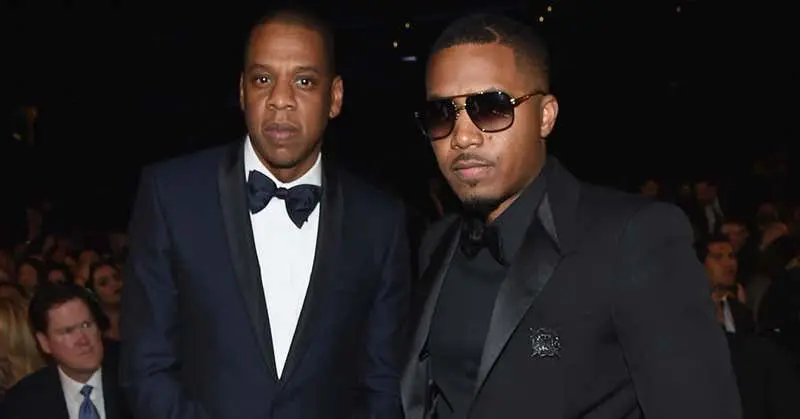
Ultimately, trying to pick a definitive “loser” is impossible because both men ascended to god-tier status. In the words of the documentary: “It’s like Shaq and Kobe.”
These were two alpha males who couldn’t coexist at their peak because the city wasn’t big enough for two Kings. This rivalry was essential to sharpen their skills.
- Jay-Z needed Nas to prove he could battle the best lyricist alive.
- Nas needed Jay-Z to prove he could stay relevant in a commercial era.
Together, they represent the two sides of the New York coin: the poetic soul of Queensbridge and the hustler ambition of Brooklyn. Without this war, hip-hop would never have reached the heights it sits on today.
[…] 0January 2, 2026 […]