Introduction
Drake’s dominance on Spotify has hit another wild chapter. Just months after breaking the 120-billion-stream barrier, the rapper’s name is now at the center of a legal storm. Veteran MC RBX has filed a class-action lawsuit accusing Spotify of turning a blind eye to billions of fake streams tied to Drake’s music, a claim that could reshape how we see streaming numbers and their credibility.
How Drake became Spotify’s king
Drake didn’t just ride the wave of streaming — he helped build it. Since the early 2010s, albums like Take Care, Views, and Scorpion turned the Toronto artist into a fixture of every major playlist. According to Chart Data, Drake hit 100 billion streams in June 2024, 110 billion in March 2025, and passed 120 billion by September.
That made him the first artist in history to reach that milestone, edging out Taylor Swift, Bad Bunny, and The Weeknd.
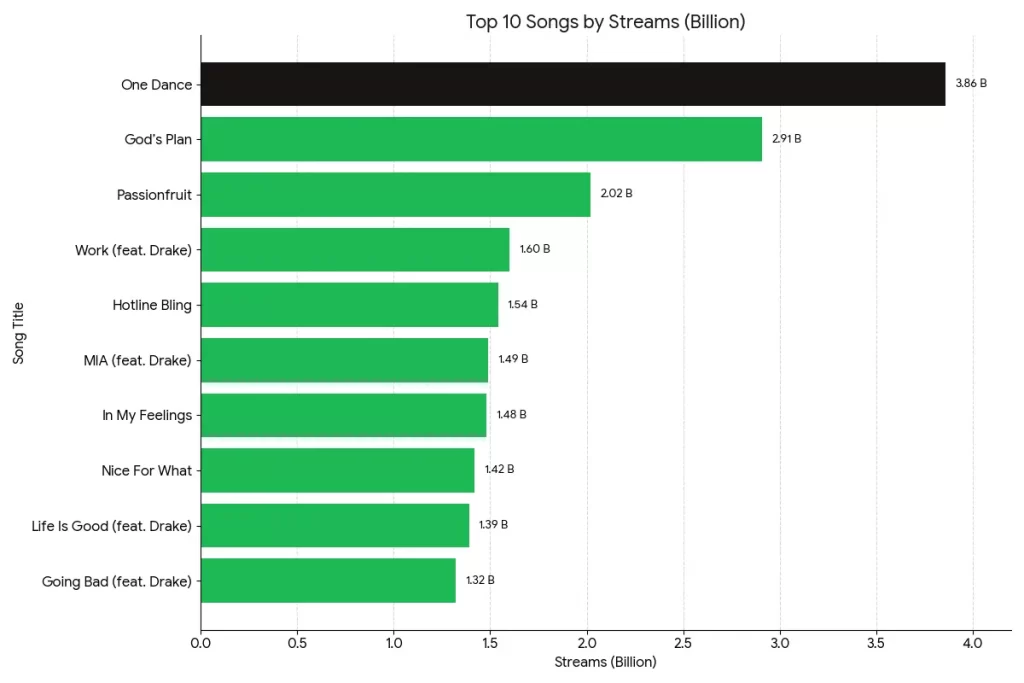
Spotify numbers show “One Dance” as Drake’s top-streamed song with over 3.8 billion plays, followed by “God’s Plan” (2.9 billion) and “Passionfruit” (2 billion). These hits have been on heavy rotation for years, proof that his catalog still fuels daily playlists worldwide.
The RBX lawsuit: what happened
In November 2025, RBX, a West Coast rap veteran and cousin of Snoop Dogg, sued Spotify in a California federal court. His claim: between 2022 and 2025, around 37 billion of Drake’s 120 billion Spotify streams came from bot accounts.
The suit argues Spotify knowingly ignored the activity to inflate engagement numbers and attract advertisers.
RBX’s legal team points to impossible patterns — accounts streaming Drake’s songs 23 hours a day, or sudden spikes for old tracks. Some plays were allegedly rerouted via VPNs from Türkiye to the UK, masking their real origin. If proven, it could mean other artists lost hundreds of millions in royalties because Spotify’s payout model is pro rata — revenue is split by total global streams, not by user behavior.
Spotify denies everything, calling the allegations “baseless” and insisting its anti-fraud systems are the best in the industry.
Why fake streams matter
Streaming fraud isn’t new, but RBX’s case targets Spotify’s accountability at scale. Under the pro-rata model, a single inflated artist can drain the revenue pool for everyone else. That’s why independent musicians have rallied around the lawsuit — arguing that the system rewards quantity over authenticity.
Spotify claims it already removes millions of “spammy” tracks and blocks royalties tied to fake plays. Still, the company’s incentive to report higher engagement raises questions about transparency and conflicts of interest.
Comparing Drake’s Spotify streams with other giants
Despite the controversy, Drake’s numbers remain staggering. His 80 million monthly listeners keep him among the platform’s most-streamed male artists ever. Only The Weeknd (122 million), Taylor Swift (109 million), and Bad Bunny (80 million) come close.
While Swift leads 2024-2025 with record female-artist streams, Drake still dominates overall catalogue volume. His 513 tracks (including features) generate more than 50 million daily plays.
The economics of streaming power
Streaming pays roughly $0.003–$0.005 per play. At 120 billion streams, that’s $360–$600 million USD in potential gross revenue, before splits with labels and collaborators. Drake’s deals with Universal Music Group and Spotify reportedly give him favorable rates, but the lawsuit puts those earnings under scrutiny.
For comparison, a global stadium tour might gross $250–$300 million — less than half what his streaming could generate. This economic leverage explains why Drake releases music frequently and collaborates across genres, from Afrobeats (One Dance) to Latin pop (MIA) and trap (Rich Flex).
The role of playlists and algorithms
Drake’s success also rides on Spotify’s playlist ecosystem. Tracks like “Hotline Bling” or “In My Feelings” stayed viral thanks to editorial lists such as RapCaviar and algorithmic boosts from user behavior. His frequent releases feed the algorithm’s appetite for engagement, keeping him ever-present on listener feeds.
Industry analysts suggest Spotify’s algorithm prioritizes retention, not discovery — meaning the more listeners stream familiar artists like Drake, the more exposure they get. It’s a feedback loop that cements the top tier while limiting newcomer visibility.
Top 10 most streamed Drake songs on Spotify
(Data: Chart Data / Kworb / Spotify November 2025)
| Rank | Song | Streams (Billion) |
| 1 | One Dance | 3.86 B |
| 2 | God’s Plan | 2.91 B |
| 3 | Passionfruit | 2.02 B |
| 4 | Work (feat. Drake) | 1.60 B |
| 5 | Hotline Bling | 1.54 B |
| 6 | MIA (feat. Drake) | 1.49 B |
| 7 | In My Feelings | 1.48 B |
| 8 | Nice For What | 1.42 B |
| 9 | Life Is Good (feat. Drake) | 1.39 B |
| 10 | Going Bad (feat. Drake) | 1.32 B |
Historical context: Drake and the rise of streaming
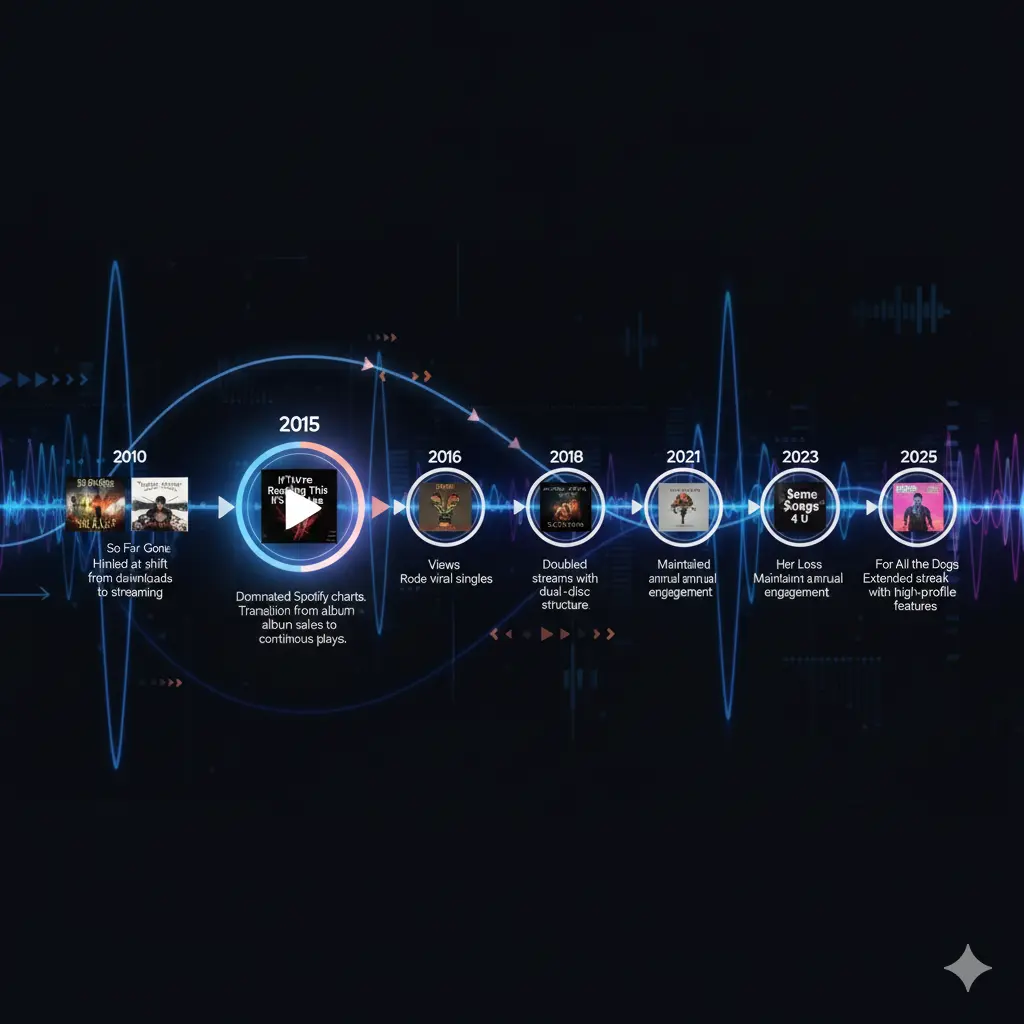
Back in 2010, Drake’s So Far Gone and Thank Me Later already hinted at a shift from downloads to streaming. By 2015, If You’re Reading This It’s Too Late dominated Spotify charts, marking the transition from album sales to continuous plays.
Each project since has capitalized on the streaming model: Views (2016) rode viral singles, Scorpion (2018) doubled streams with a dual-disc structure, Certified Lover Boy (2021) and Her Loss (2022) maintained annual engagement. For All the Dogs (2023) and $ome $exy $ongs 4 U (2025) extended that streak with high-profile features.
Regional and demographic trends
Drake’s streams are strongest in the United States, United Kingdom, Canada, Brazil, and Nigeria. Gen Z (ages 18–25) drives most of his Spotify traffic, with consistent spikes during album drops and meme trends. His collaborations with global acts like Bad Bunny and Wizkid broadened his reach across Latin America and Africa.
The broader question: can we trust streaming numbers?
The RBX case forces a bigger debate: are streaming counts still reliable indicators of cultural impact? Between AI-generated tracks, bot farms, and algorithmic manipulation, raw numbers no longer tell the full story.
If Spotify’s model rewards inflated metrics, the credibility of its charts and awards could crumble. Transparency reports, third-party audits, and blockchain-based tracking may be the next step toward rebuilding trust.
What’s Next
Spotify’s legal response is pending, and analysts expect months of data audits and court filings. Regardless of the verdict, the RBX lawsuit highlights a critical moment: streaming success now needs scrutiny, not blind celebration.
Meanwhile, Drake keeps breaking records. Whether his 120 billion Spotify streams are all authentic or partly automated, his cultural footprint remains undeniable.
If you want to learn more about Drake’s lawsuit against UMG, read our article Drake Suing UMG: What Really Happened.
And if you want to know why Drake filed the lawsuit against UMG, check out our article Drake vs Kendrick Timeline (2009–2025): The Definitive Guide.


[…] 0November 7, 2025 Diverse Mentality […]