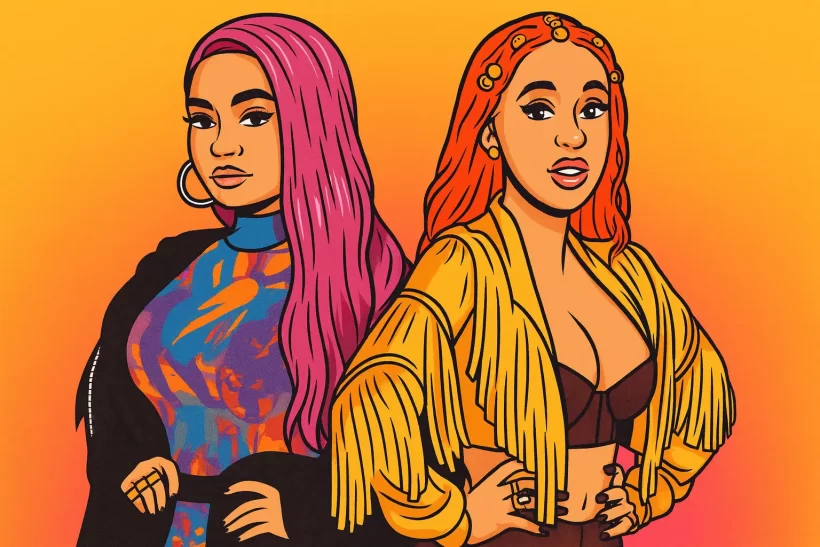
Before diving into everything about the Nicki Minaj and Cardi B feud, read our article on women in Hip Hop.
| Metric | Nicki Minaj (the Queen) | Cardi B (the Challenger) |
| Debut Album | Pink Friday (2010) | Invasion of Privacy (2018) |
| Key Diss Track | “No Frauds” (Subliminal) | “She Bad” / Social Media Rants |
| Style / Archetype | Lyrical Technician / The Architect | Raw Charisma / The Disruptor |
| Biggest Controversy | Harper’s Bazaar Shoe Throw (2018) | Twitter War over Children (2025) |
| Fanbase Name | The Barbz | Bardi Gang |
The beginning of a Hip Hop Cold War (2017–2018)
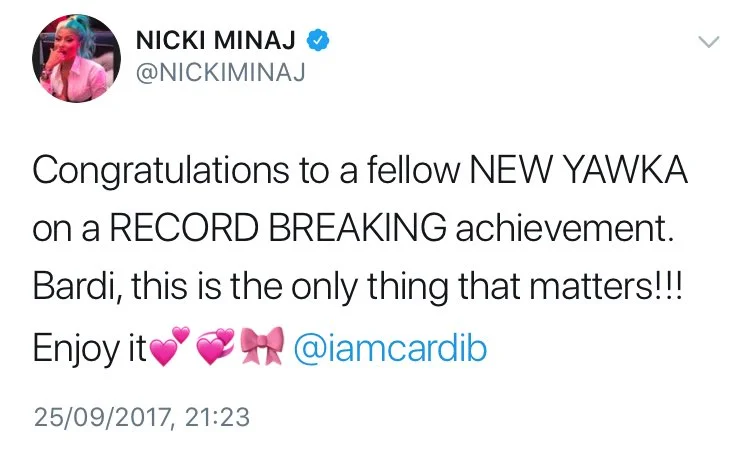
The Nicki Minaj and Cardi B feud is one of hip-hop’s most dissected rivalries. However, this clash isn’t unprecedented. It echoes the raw energy of the mid-80s, specifically the Roxanne Wars, where female rappers first established that lyrical warfare could be a career-defining move. It began in 2017, when Cardi B’s hit “Bodak Yellow” reached No. 1 on the Billboard Hot 100. The celebration soon turned into speculation: was the newcomer replacing the reigning queen?
The supposed tension grew when both rappers featured on Migos’ “MotorSport”. The separate video shoots sparked rumors of division. Despite public denials, online communities and gossip outlets turned artistic collaboration into a rivalry narrative.
The 2018 Harper’s Bazaar Icons Party became the breaking point. Cardi confronted Nicki over comments about her motherhood. The clash — complete with a thrown shoe and viral footage — became an instant pop culture landmark.
From truce to tension: media narratives and fan wars (2019–2022)
After the NYFW incident, public statements called for peace. Yet the feud thrived online, shaped by fan dynamics and media algorithms.
Nicki used her Queen Radio platform for commentary, while Cardi spoke directly to her fans through Instagram Live. Their fanbases — the Barbz and the Bardi Gang — clashed daily, forming one of the most active digital rivalries in pop culture.
This era also saw critics examining gender bias in rap, where female artists are often portrayed as competitors rather than collaborators. The feud exposed the intersection of sexism, authenticity, and entertainment economics in hip-hop.
Fashion and symbolism (2023)
By 2023, both artists had evolved their brands beyond music. But at the MTV VMAs, subtle body language and unspoken tension revived the drama.
Nicki’s husband Kenneth Petty reignited headlines by confronting Offset, leading to a legal reprimand. Meanwhile, fashion became metaphor. At events like Fashion Week and Harper’s Bazaar, both used couture as self-expression: Nicki’s regal armor versus Cardi’s modern glamour.
This stage of the feud showed how style operates as a cultural weapon, a coded language of dominance, self-assertion, and brand identity.
The resurgence (2024–2025)
Cardi’s 2025 album Am I the Drama? reignited the feud. Lines from “Imaginary Playerz” (“Striped like Thom Browne, these bitches should calm down”) were read as subliminal shots at Nicki’s Met Gala outfit.
Nicki responded with cryptic tweets on X, mocking sales and calling Cardi “Barney B.” Cardi replied, labeling her “Cocaine Barbie.” The feud went viral again, with screenshots, memes, and fan edits dominating the web.
Their fanbases became amplifiers of every insult. What had started as a creative rivalry turned into a public case study on how digital culture monetizes conflict.
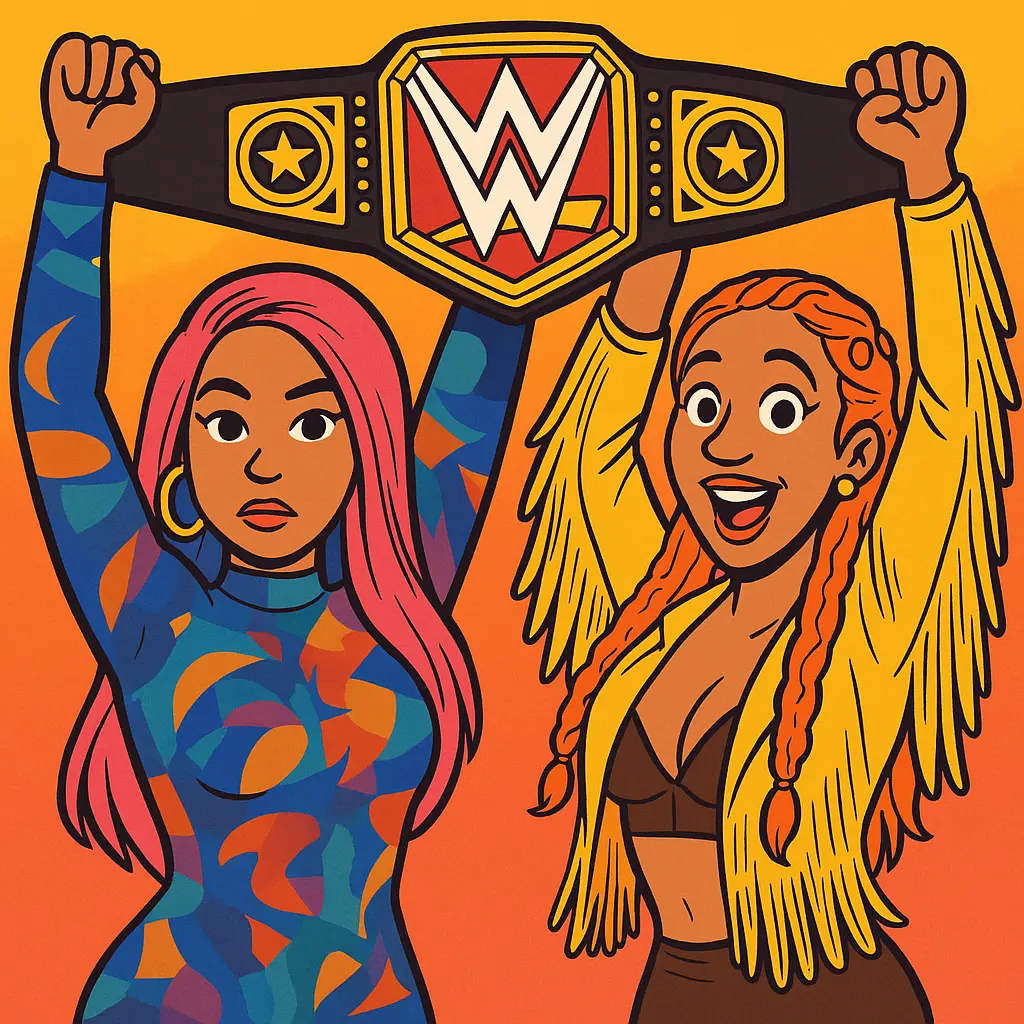
Why do Nicki Minaj and Cardi B hate each other? (The real reasons)
This lens transforms the feud from a tabloid story into a sociological case. It shows how fame operates within a system of performance, power, and perception. Here are the core drivers of the conflict:
- The “Highlander” Syndrome (gender dynamics): the industry often pushes the narrative that there can only be one “Queen of Rap” at a time. This scarcity mindset forces female artists into competition rather than collaboration, unlike their male counterparts who often coexist at the top.
- Media construction: gossip outlets and music blogs often manufacture drama to drive traffic. They frame innocuous comments as “shots,” turning small misunderstandings into headline-grabbing wars for clicks.
- Digital amplification: social media algorithms prioritize conflict and outrage over music. Platforms reward artists for keeping the feud alive, incentivizing a cycle of subliminal tweets and Instagram responses.
- Weaponized fandoms (fan toxicity): “Stan wars” turned music fandom into psychological combat. The Barbz and Bardi Gang often escalate tensions on behalf of the artists, making de-escalation almost impossible without disappointing the core base.
- Financial incentives: record labels and managers know that beef sells records. Controversy generates attention, and in the streaming era, attention equals currency—even if the attention is negative.
Lyrical and visual symbolism
Nicki’s lyrical strategy asserts hierarchy: “Everything you getting, little hoe, is ’cause of me.”
Cardi’s bars counter with self-made power: “I’m a legend, they gon’ hang my heels from the power lines.”
Both use fashion and gesture as semiotic weapons: Nicki’s luxury ensembles suggest control; Cardi’s street-informed confidence suggests rebellion.
This duality illustrates how rap performance merges with visual art and cultural semiotics.
Media and public perception
From TMZ exclusives to YouTube breakdowns, the media’s echo chamber intensifies every dispute. Both artists understand the economy of outrage and use it strategically.
Influencers, journalists, and fans all participate, blurring the line between journalism and entertainment.
Public impact and legacy
The feud reshaped how the Hip Hop industry markets women. Competition became spectacle; collaboration became rare.Yet, paradoxically, both artists opened the door for a new generation (Megan Thee Stallion, Doja Cat, Ice Spice, Latto) to claim visibility. The conflict ultimately expanded female representation within rap.
Where things stand in 2025
After weeks of online warfare, Cardi posted an open letter urging Nicki to “seek help.” Nicki countered by reframing the feud as a moral crusade.
What began as lyrical tension has turned into a mirror of modern celebrity, raw, public, and algorithm-driven.
Conclusion: beyond the feud
The Nicki Minaj and Cardi B saga transcends gossip. It reflects how power, fame, and identity intersect in the age of social media.
Nicki remains the seasoned architect of image control; Cardi the spontaneous force of authenticity. Together, they represent two ends of the same cultural spectrum — discipline and disruption.
The real question isn’t who won, but what the world learned from watching it unfold.
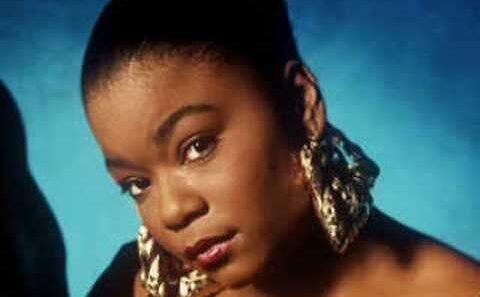
[…] Yet Kim’s technical delivery, iconic fashion, and boundary-pushing visuals influenced an entire generation, including Nicki Minaj, Cardi B, and Megan Thee Stallion.Read our article about Nicki Minaj and Cardi B feud. […]
[…] Shanté didn’t just participate; she dominated. In a male-dominated era, she was the aggressor. Rather than just singing hooks, she was taking heads. Her fearless approach paved the way for the evolution of women in Hip Hop, proving that a female MC could carry a label on her back. Without her blueprint, we might never have seen the rise of legends like Salt-N-Pepa and MC Lyte, or the fierce modern dynamics behind rivalries like Nicki Minaj vs Cardi B. […]